
TPM ROI
From operating expense to generator of cash flow and margin
TPM transforms every dollar invested into recurring savings and sustainable productivity. It directly impacts your costs, frees up cash flow, and expands your profitability year after year.
How is the TPM investment reflected in the ROI?
Recurring operational cost reduction:
Less scrap, rework, downtime, overtime, external services.
These savings are recurring and accumulate month after month.
Higher productivity with the same resources:
The same human and technical team produces more useful units, with less effort.
Improves unit cost and profitability per line or plant.
Utilization of installed capacity:
By eliminating losses, the need to invest in new machinery or lines is postponed or avoided.
Better cash flow control:
Fewer emergencies, better planning, reduction of emergency purchases and unnecessary inventory.
Extended asset useful life:
Equipment lasts longer and is maintained at a lower cost, reducing accelerated depreciation or early replacement.
Operating margin increase:
Lower costs + more good units = more margin with the same infrastructure.
Direct return on each improvement:
TPM companies typically measure the economic benefit of each implemented improvement (avoided cost, gained productivity, energy savings, etc.).
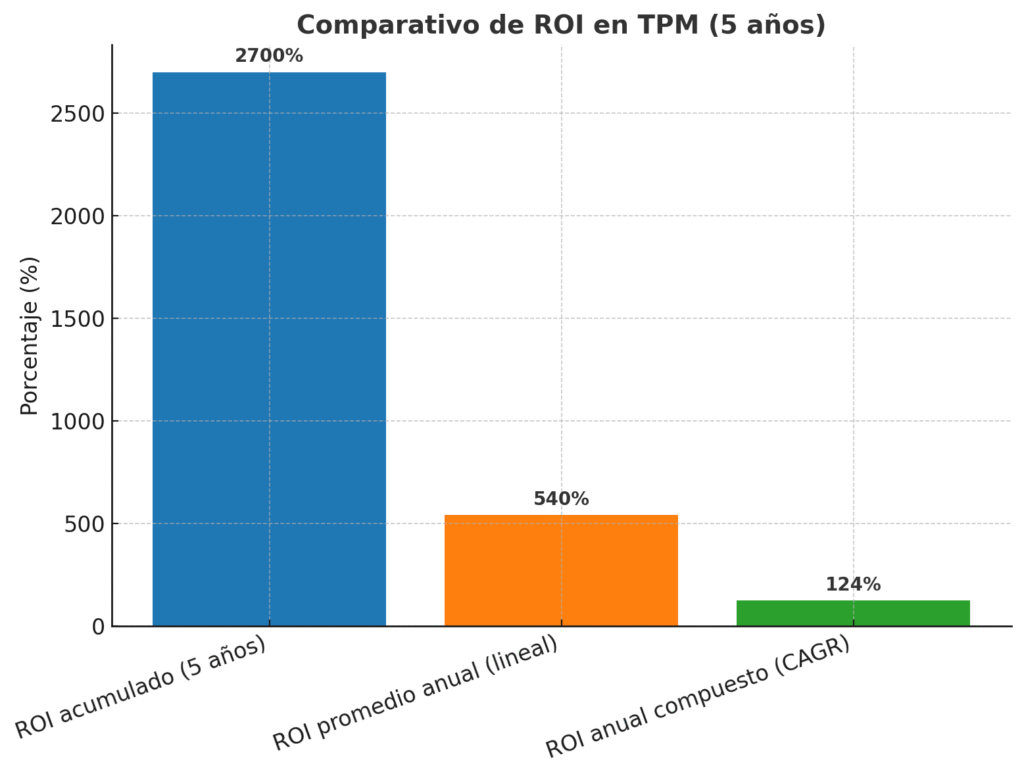
Financial example
1) Cumulative 5-Year ROI
Financial Impact: for every dollar invested in TPM, the company obtained 27 dollars in returns over 5 years.
2) Average Annual ROI (linear)
Financial Impact: on average, each year the return was 5.4× the annual investment.
3) Compound Annual ROI (CAGR)
Financial Impact: even with a conservative calculation, TPM generated around 95% annually, practically doubling the investment each year.
Conclusion
Presented in any of its forms, the impact is compelling: a modest investment in TPM translated into millions of dollars in sustainable savings, with a financial return difficult to match by any other operational initiative.